Most small businesses don’t lose customers because of bad service — they lose them because a follow-up email never got sent, a lead sat untouched for two weeks, or nobody remembers what was promised on the last call. A spreadsheet can only hide that problem for so long.
A CRM (customer relationship management tool) fixes this by giving every lead, deal, and conversation one home instead of three inboxes and a notebook. The hard part isn’t deciding whether to get one — it’s picking the right one, since most small teams don’t need the enterprise feature list that comes with an enterprise price tag. This guide compares five of the strongest small-business CRMs on the market right now, so you can pick based on how you actually sell — not on whichever tool has the loudest marketing. It pairs well with our guide on social media marketing fundamentals if lead generation, not just lead management, is your current bottleneck.
Quick Answer
The best CRM for small businesses depends on your sales style. HubSpot CRM is the strongest free option and the easiest to start with today. Zoho CRM (or its lighter sibling, Bigin) offers the most features per dollar as you scale past a free plan. Pipedrive is built specifically for sales-pipeline visibility, not marketing. Salesforce Starter Suite is the better long-term choice if you expect to outgrow “small business” within a couple of years. Freshsales stands out for teams that live on the phone and in chat, not just email. There’s no universal winner — the right pick matches your sales process, not the other way around.
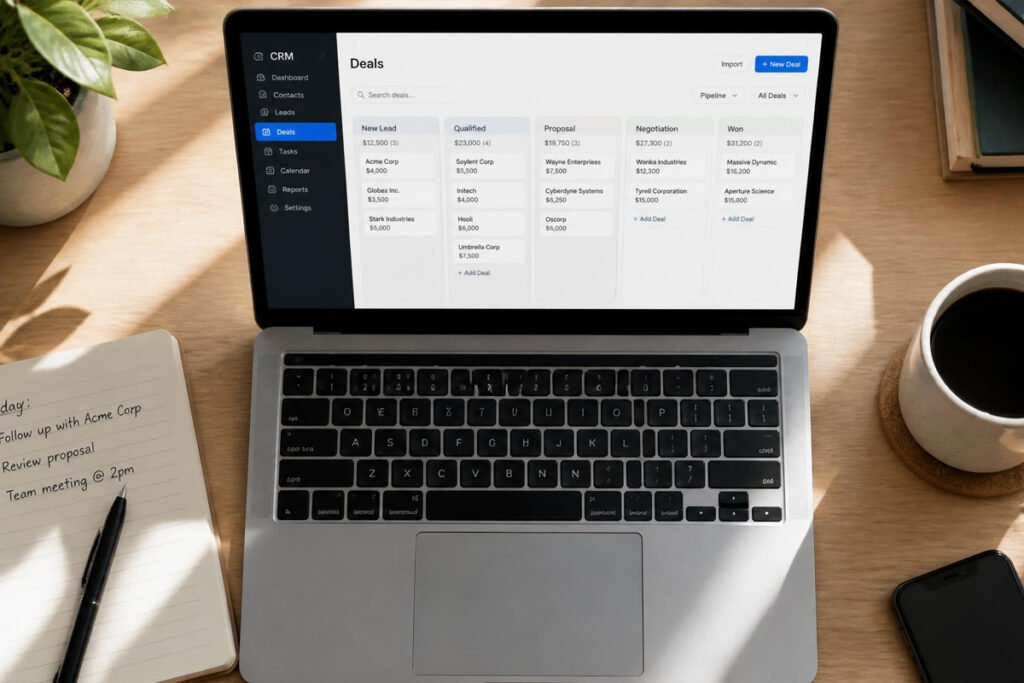
Table of Contents
- What Is a CRM and Why Small Businesses Need One
- How to Choose the Right CRM
- Best CRM Software for Small Businesses
- CRM Comparison Table
- Best CRM for Different Business Types
- How to Set Up Your CRM Correctly
- Common CRM Mistakes
- Expert Tips
- Final Thoughts
- FAQ
What Is a CRM and Why Small Businesses Need One
A CRM is software that tracks every interaction a business has with a lead or customer — first contact, follow-ups, deals in progress, and post-sale communication — in one searchable place. Instead of a founder remembering who to follow up with, the system tells them.
For small teams specifically, the value isn’t the reporting dashboards enterprise buyers care about. It’s the basics done reliably: no lead falls through the cracks, no follow-up gets forgotten, and anyone on the team can pick up a conversation without starting from zero. That reliability compounds the same way consistent content marketing does — the value shows up months later, not on day one.
How to Choose the Right CRM
Before comparing feature lists, answer three questions:
- How does your team actually sell? Pure pipeline-and-deals selling needs a different tool than a business that also runs email marketing through the same system.
- What’s your realistic budget once you outgrow the free tier? Most “free” CRMs get expensive fast once you add seats, automation, or AI features — read the pricing page for the tier you’ll actually need in a year, not the entry tier.
- How much setup time can you afford? According to buyer research from Capterra, most small businesses trial software for about 30 days before committing — treat that window as time to test real workflows, not just click around.

Best CRM Software for Small Businesses
1. HubSpot CRM
Overview: HubSpot’s core CRM is free with unlimited users, which makes it the most common starting point for small teams. It covers contact and deal management, email tracking, and basic marketing tools out of the box, with paid Marketing, Sales, and Service Hubs layered on top as you grow.
Key Features:
- Free forever plan with unlimited users and contact/deal tracking
- Native email tracking and templates
- Strong integration with content and marketing workflows
- AI features (Breeze) available on paid tiers
Best For: Businesses that want marketing and sales data in one system from day one.
Pros: ✅ Genuinely usable free plan ✅ Easiest learning curve ✅ Scales into full marketing automation Cons: ❌ Paid tiers get expensive per seat ❌ Some advanced automation locked behind higher plans
Our Verdict: The default starting point for most small businesses, especially ones already thinking about a real content marketing strategy alongside sales tracking.
2. Zoho CRM (and Bigin)
Overview: Zoho CRM is built for teams that want deep customization without an enterprise price tag. Its lighter sibling, Bigin, strips the feature set down to essentials for very small teams and has been recognized as an editor’s pick for small-business CRMs in 2026.
Key Features:
- AI-assisted forecasting and lead scoring (Zia)
- Highly customizable pipelines and dashboards
- Bigin option for teams that find full Zoho CRM too complex
- Strong value at lower price points than most competitors
Best For: Growing teams that have outgrown a free CRM but aren’t ready for enterprise pricing.
Pros: ✅ Best feature-to-cost ratio in this list ✅ Flexible customization ✅ Bigin option for simpler needs Cons: ❌ Steeper learning curve than HubSpot ❌ Free tier is limited to a small number of users
Our Verdict: The strongest pick once budget matters as much as features — especially for teams willing to spend a bit more setup time for long-term flexibility.
3. Pipedrive
Overview: Pipedrive is a sales-first CRM, not a marketing platform with a CRM bolted on. Its visual, drag-and-drop pipeline is built specifically to answer one question: what deal needs attention right now.
Key Features:
- Visual pipeline management as the core interface
- Activity-based selling reminders (calls, follow-ups, tasks)
- Straightforward reporting focused on deal progress
- Lighter marketing feature set than HubSpot or Zoho
Best For: Sales-driven small businesses that don’t need built-in marketing automation.
Pros: ✅ Very intuitive for salespeople specifically ✅ Fast to set up ✅ Clear pipeline visibility Cons: ❌ Marketing features are limited or require add-ons ❌ Less useful if sales and marketing need to share one system
Our Verdict: A strong fit if your team already runs paid media or outbound campaigns elsewhere and just needs a clean place to manage the resulting conversations.
4. Salesforce Starter Suite
Overview: Salesforce’s small-business entry point is built to be the on-ramp to the same platform enterprise companies use — meaning less risk of outgrowing it and needing a full system migration later.
Key Features:
- Built-in AI for summarizing customer histories and drafting emails
- Fast setup with pre-built templates for small teams
- Clear upgrade path into advanced Salesforce editions
- Wide third-party integration ecosystem
Best For: Businesses that expect meaningful growth in the next 1–2 years and want to avoid a painful CRM switch later.
Pros: ✅ Scales further than any other tool on this list ✅ Strong AI assistance included ✅ Minimal migration risk later Cons: ❌ More than most very small teams need on day one ❌ Full platform depth can feel like overkill early on
Our Verdict: Worth the extra setup time only if growth, not just organization, is the goal.
5. Freshsales
Overview: Freshsales is built around communication — email, phone, and chat live inside the same record as the deal itself, which suits teams that talk to leads more than they email them.
Key Features:
- Built-in multichannel communication (email, phone, chat, SMS)
- AI-generated deal insights and email drafting
- Smart segmentation for marketing follow-up
- Automated lead routing to the right salesperson
Best For: Teams that close deals over calls and chat, not just email sequences.
Pros: ✅ Communication tools built in, not bolted on ✅ Useful AI insights for prioritizing deals ✅ Solid automation for lead routing Cons: ❌ Less well-known than the other four, smaller integration ecosystem ❌ Best features concentrated in mid-to-upper tiers
Our Verdict: Worth shortlisting specifically if your sales process is conversation-heavy rather than form-and-email-heavy.
CRM Comparison Table
| CRM | Best For | Free Plan | Learning Curve | Marketing Features |
|---|---|---|---|---|
| HubSpot CRM | All-in-one marketing + sales | Yes, unlimited users | Easy | Strong |
| Zoho CRM / Bigin | Budget-conscious, growing teams | Limited (Zoho) | Moderate | Moderate |
| Pipedrive | Pure sales pipeline management | No (trial only) | Easy | Light |
| Salesforce Starter Suite | Businesses planning to scale fast | No (trial only) | Moderate | Moderate–Strong |
| Freshsales | Call/chat-heavy sales teams | Limited | Moderate | Moderate |
Best CRM for Different Business Types

Solo Founders & Very Small Teams
Start with the free tier of HubSpot or Bigin. At this stage, the goal is simply replacing spreadsheets and sticky notes — advanced automation isn’t worth the setup time yet. Pair it with a lightweight content creation routine so leads have somewhere consistent to come from.
Sales-Led Teams (Agencies, B2B Services)
Pipedrive or Freshsales tend to fit best here, since the priority is pipeline visibility and follow-up discipline over marketing automation. If most leads currently come from Google Ads or SEO, a sales-first CRM keeps the handoff from marketing to sales clean.
Growth-Stage Small Businesses
If hiring plans or funding suggest real growth ahead, Zoho CRM or Salesforce Starter Suite reduce the odds of a painful migration in 18 months. It costs more setup time now to save a much more expensive switch later.
How to Set Up Your CRM Correctly
Step 1: Map Your Actual Sales Process First
Before touching software, write down your real stages — first contact, qualified, proposal, closed. Configuring a CRM around a process that doesn’t exist yet is the most common reason adoption fails.
Step 2: Import Clean Data, Not Everything
Bring in active leads and recent customers first. A CRM stuffed with five years of stale contacts is harder to trust and use than one that starts small and grows.
Step 3: Set Up Only the Automations You’ll Actually Use
Start with one or two — a follow-up reminder, a new-lead notification. Adding ten automations in week one usually means none of them get reviewed or trusted.
Step 4: Get the Whole Team Using It From Day One
A CRM that only the owner updates isn’t a CRM, it’s a personal notebook with software. Make entry a required part of every deal, not an optional extra step.
Step 5: Review and Simplify Monthly
Every 30 days, check which fields, stages, or automations nobody’s using — and remove them. A CRM that stays simple gets used; one that grows unchecked gets ignored.
Common CRM Mistakes
Choosing based on features instead of actual sales process. The CRM with the longest feature list isn’t the best fit if half those features go unused. Match the tool to how deals actually move through your business.
Skipping team buy-in before rollout. A CRM introduced without explaining why it matters to the people using it daily tends to get quietly abandoned within a few months — the same adoption problem that shows up in digital marketing mistakes more broadly: tools without a habit behind them rarely stick.
Treating the free tier as permanent. Free plans are great for testing, but budgeting for the paid tier you’ll actually need avoids a scramble — and a data migration — six months in.

Expert Tips
Trial with real leads, not test data. Fake contacts don’t reveal whether a CRM actually fits your workflow. Run one real week of leads through each shortlisted tool before deciding.
Connect your CRM to your marketing channels early. A CRM that’s disconnected from social media or ad campaigns creates the same reporting blind spots we cover in SEO vs. Google Ads ROI — you can’t tell what’s actually working if the data lives in separate systems.
Don’t let AI features replace judgment. AI-drafted emails and deal scoring are useful starting points, not final answers — the same caution we’d apply to any AI tool in a business workflow.
Final Thoughts
Best overall for most small businesses: HubSpot CRM, for its free tier and easy learning curve. Best budget pick as you scale: Zoho CRM or Bigin. Best for pure sales teams: Pipedrive. Best for businesses planning serious growth: Salesforce Starter Suite. Best for conversation-heavy sales: Freshsales.
Whichever you choose, the CRM itself is only half the equation — it’s most valuable when it’s connected to a real lead-generation engine. If that’s the current gap, our guides on building a content marketing strategy and local SEO are good next steps.
Frequently Asked Questions
Do small businesses actually need a CRM, or is a spreadsheet enough? A spreadsheet works for a handful of leads a month. Once follow-ups start slipping or more than one person needs to see the same customer history, a CRM pays for itself quickly.
How much does a CRM typically cost for a small business? Several tools offer usable free tiers for very small teams. Paid plans generally start in the range of $9–20 per user per month, with AI and advanced automation features often priced separately or on higher tiers.
Which CRM is easiest to learn for a non-technical team? HubSpot CRM and Pipedrive are generally considered the easiest to onboard a non-technical team onto quickly.
Can I switch CRMs later without losing my data? Yes, most CRMs support data export, though the ease of migration varies. This is exactly why growth-stage businesses often choose a platform like Salesforce Starter Suite upfront — to avoid a harder switch later.
Do I need a CRM with built-in marketing automation, or is a separate tool better? It depends on team size. Small teams generally benefit from having both in one system (like HubSpot); larger or more specialized teams sometimes prefer dedicated tools for each function.
Is a free CRM plan actually usable, or just a trial in disguise? Some, like HubSpot’s core CRM, are genuinely usable long-term with real limitations rather than a time-boxed trial. Others cap free use at a very small number of users or contacts, functioning more like an extended trial.
How long does it take to fully set up a CRM? Basic setup — pipeline stages, importing active contacts — usually takes a few hours to a few days. Full team adoption and workflow refinement typically takes 4–6 weeks.
Does a CRM help with SEO or content marketing, or is it purely for sales? Indirectly, yes — a CRM shows which content and channels actually produce customers, not just leads, which sharpens decisions across your broader SEO and content efforts.
What’s the biggest reason small businesses abandon a CRM after adopting one? Poor team adoption, usually because the tool was configured around features instead of the team’s actual sales process — see the mistakes section above.
Author: DIGI MONETIZE Team Last Updated: August 2026