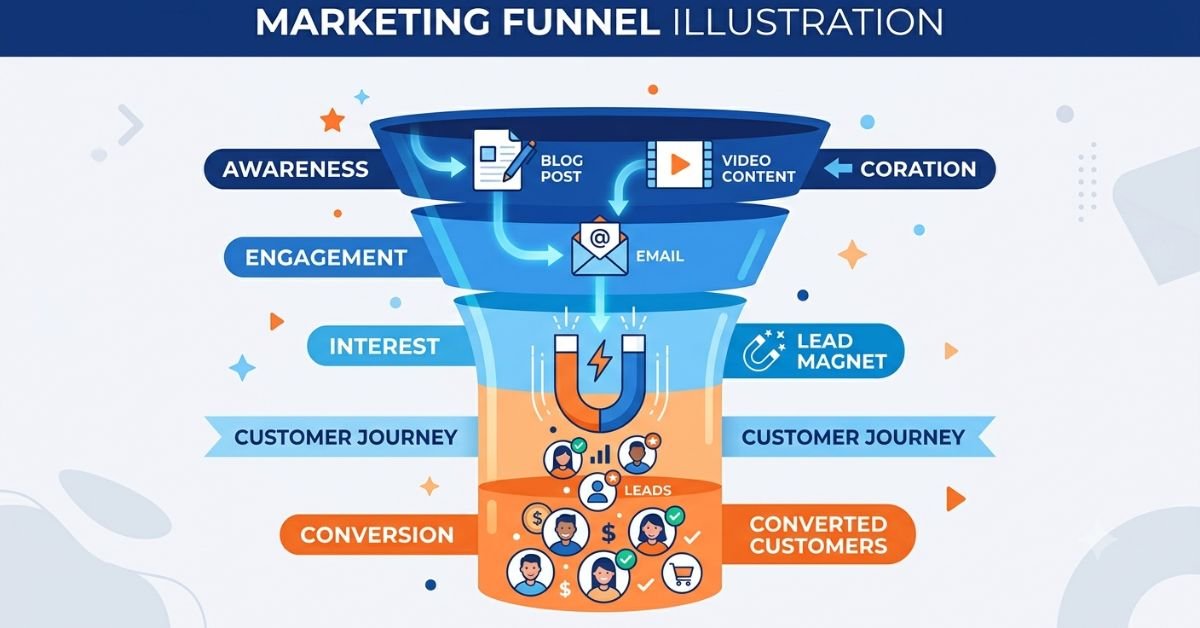
Most businesses publish content. Very few generate leads from it.
You’ve probably felt this gap yourself. You write blog posts. You post on LinkedIn. You maybe even hire a freelancer to pump out articles every week. And yet, your inbox stays quiet. Your demo requests don’t budge. Your traffic might even be climbing — but your pipeline isn’t.
That’s not a content problem. It’s a strategy problem.
Content marketing only generates leads when it’s built around a system: the right audience, the right topics, the right funnel, and the right conversion points. Random blog posts, no matter how well-written, rarely move the needle. A content marketing strategy that generates leads treats every article, video, and email as a deliberate step toward a business outcome.
In this guide, you’ll learn exactly how to build that system — from audience research and keyword strategy to funnel design, content calendars, lead magnets, promotion, and measurement. By the end, you’ll have a practical, repeatable framework you can start applying today.
Table of Contents
- What Is a Content Marketing Strategy?
- Why Content Marketing Generates High-Quality Leads
- Understand Your Target Audience
- Set SMART Marketing Goals
- Perform Keyword Research
- Build a Lead-Generating Content Funnel
- Choose the Best Content Types
- Create an Effective Content Calendar
- Optimize Every Piece of Content for SEO
- Create Powerful Lead Magnets
- Optimize Calls-to-Action
- Promote Your Content
- Measure Content Marketing Performance
- Common Content Marketing Mistakes
- Real-World Example of a Successful Content Marketing Funnel
- FAQ
- Conclusion
What Is a Content Marketing Strategy?
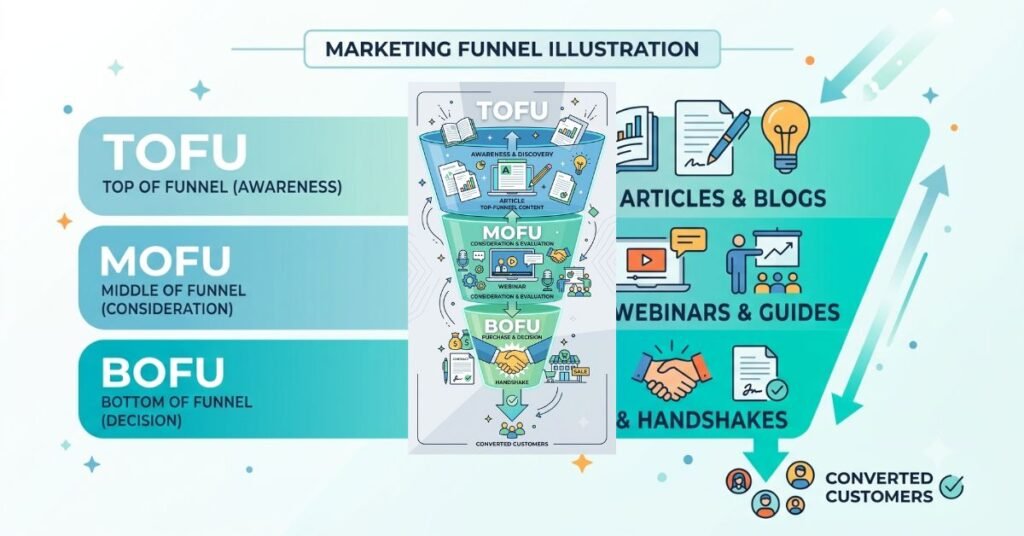
A content marketing strategy is a documented plan that guides what content you create, who it’s for, and how it moves people toward becoming customers.
It’s different from just “doing content marketing.” Content marketing is the activity — writing blogs, filming videos, sending newsletters. A content strategy is the plan behind that activity: your goals, your audience, your topics, your funnel stages, and your metrics for success.
Core components of a content marketing strategy:
- A clearly defined target audience and buyer personas
- Business goals tied to content (traffic, leads, sales)
- A content funnel mapped to the buyer journey
- A recurring content calendar
- SEO and distribution plans
- Lead capture mechanisms (forms, magnets, CTAs)
- Metrics and reporting cadence
💡 Expert Tip #1: Before creating a single piece of content, write down your strategy on one page. If you can’t summarize your content strategy in a few sentences, it’s not a strategy yet — it’s a wish list.
The benefit of having a real strategy is compounding value. A single blog post might bring in a handful of visitors. A strategy, executed consistently over months, builds an asset that keeps generating leads long after the content is published.
Why Content Marketing Generates High-Quality Leads
Content marketing generates high-quality leads because it builds trust before the sales conversation ever starts. By the time someone fills out your contact form, they’ve already educated themselves using your content — which means they arrive warmer, more informed, and more likely to convert.
Here’s why it works so well:
People buy from businesses they trust. Helpful, honest content demonstrates expertise long before a prospect talks to your sales team.Unlike paid ads, a well-optimized blog post can keep ranking and attracting visitors for years without ongoing ad spend.
Businesses that consistently publish useful content are perceived as leaders in their space, which increases willingness to buy.Educated leads close faster and churn less, because they already understand your value proposition.
Visitors who land on your site through informative content already have a related need — they’re not cold traffic. Content is an asset. Once published and optimized, it keeps generating leads without recurring media spend, unlike paid campaigns that stop the moment you stop paying.
Industry benchmarks commonly cited by marketing organizations show that content marketing tends to cost meaningfully less than outbound marketing while generating a higher volume of leads over time — which is why so many B2B and SaaS companies treat content as a core, not optional, growth channel.
💡 Expert Tip #2: Track cost-per-lead separately for organic content versus paid channels. Most teams are surprised how much cheaper organic leads become after month six.
Understand Your Target Audience
You cannot build a lead-generating content strategy without knowing exactly who you’re writing for. Vague audiences produce vague content, and vague content doesn’t convert.
Build Buyer Personas
A buyer persona is a semi-fictional profile of your ideal customer, based on research rather than assumptions. At minimum, define:
- Job title and industry
- Company size (for B2B)
- Goals and challenges
- Where they search for information
- Objections that stop them from buying
Example: A B2B SaaS company selling project management software might define a persona like “Operations Manager Olivia” — mid-sized company, frustrated with spreadsheet chaos, searches Google for “best project management tools for teams,” and hesitates because of integration concerns.
Research Pain Points
Use real sources instead of guesswork:
- Customer support tickets and sales call recordings
- Reviews of competitor products
- Reddit and Quora threads in your niche
- Direct customer interviews
Map Search Intent to the Customer Journey
Every search query reflects a stage of buyer intent:
- Informational (“what is inbound marketing”) = early-stage, TOFU
- Commercial investigation (“best CRM software for small teams”) = mid-stage, MOFU
- Transactional (“buy CRM software”) = late-stage, BOFU
💡 Expert Tip #3: Create one “audience research doc” shared across marketing, sales, and support. Sales conversations reveal objections content alone never will.
Set SMART Marketing Goals

Content without goals is just publishing for the sake of publishing. Every content marketing strategy needs SMART goals — Specific, Measurable, Achievable, Relevant, and Time-bound.
Typical goals to set include:
- Traffic: Grow organic sessions by a defined percentage over 6–12 months
- Leads: Generate a target number of marketing-qualified leads (MQLs) per month
- Email subscribers: Grow your list by a set number monthly through gated content
- Sales: Attribute a percentage of closed revenue to content-sourced leads
- ROI: Track content marketing spend against pipeline generated
Example KPI table:
| Goal | Metric | Target (6 months) |
| Organic traffic | Sessions/month | +150% |
| Lead generation | MQLs/month | 200 |
| Email list growth | New subscribers/month | 500 |
| Content-sourced revenue | % of total revenue | 20% |
💡 Expert Tip #4: Set a “leading” metric (traffic, engagement) and a “lagging” metric (leads, revenue) for every goal. Leading metrics tell you if you’re on track months before lagging metrics catch up.
Perform Keyword Research
Keyword research ensures your content matches what your audience is actually typing into Google — not what you assume they’re searching for.
Match Keywords to Search Intent
- Informational keywords (“how to build a content strategy”) — best for TOFU blog content
- Commercial keywords (“best content marketing tools”) — best for MOFU comparison content
- Transactional keywords (“content marketing agency pricing”) — best for BOFU landing pages
Recommended Keyword Research Tools
- Google Keyword Planner — free, good for search volume estimates
- Ahrefs — in-depth keyword difficulty and competitor gap analysis
- SEMrush — strong for content gap and ranking analysis
- Ubersuggest — budget-friendly option for small businesses
- Google Search Console — reveals what you already rank for (often overlooked)
💡 Expert Tip #5: Start keyword research inside Google Search Console before any paid tool. You’ll often find “striking distance” keywords — ones you already rank for on page two — that are far easier to push to page one than starting from zero.
Build a Lead-Generating Content Funnel

A content funnel maps content to each stage of the buyer journey — Top of Funnel (TOFU), Middle of Funnel (MOFU), and Bottom of Funnel (BOFU). Without this structure, most content strategies generate traffic but not leads, because there’s no clear content designed to actually push someone toward a decision.
TOFU: Awareness Stage
Goal: attract strangers and introduce them to a problem they may not have fully named yet.
Content types:
- Blog posts answering broad informational questions
- Educational videos
- Social media posts
- Infographics
MOFU: Consideration Stage
Goal: help prospects evaluate solutions and position your brand as a serious option.
Content types:
- Case studies
- Webinars
- Email newsletters
- Comparison guides (“X vs. Y”)
BOFU: Decision Stage
Goal: convert warm, ready-to-buy prospects into leads or customers.
Content types:
- Free consultations
- Product demos
- Testimonials
- Pricing pages
- Customer success stories
💡 Expert Tip #6: Audit your existing content library and tag every piece by funnel stage. Most companies discover they have 80% TOFU content and almost nothing for MOFU and BOFU — which explains why traffic isn’t converting.
Choose the Best Content Types
Different content types serve different funnel stages and different audience preferences. Here’s when to use each:
- Blog posts — best for SEO-driven TOFU traffic and answering specific questions
- Videos — high engagement, great for complex or visual topics, strong on YouTube and social
- Podcasts — build long-term trust with a niche, engaged B2B audience
- Email newsletters — nurture leads already in your funnel
- Whitepapers — establish deep authority for B2B and enterprise buyers
- eBooks — effective lead magnets for MOFU content gating
- Webinars — combine education and live interaction; strong MOFU/BOFU conversion tool
- Templates and checklists — quick-win lead magnets with high perceived value
- Case studies — powerful BOFU content that overcomes buying objections
- Interactive tools (calculators, quizzes) — highly shareable and engagement-boosting
💡 Expert Tip #7: Don’t try to do all ten formats at once. Pick two or three formats your audience actually consumes, and repurpose one core piece of content into each format instead of creating everything from scratch.
Create an Effective Content Calendar
A content calendar keeps your strategy consistent instead of reactive. Consistency, more than any single “viral” piece, is what compounds into steady lead flow.
Key elements to plan:
- Publishing frequency — realistic and sustainable beats frequent and inconsistent
- Topic clustering — group content around pillar topics with supporting subtopics for stronger SEO authority
- Seasonal planning — map content to industry events, product launches, and seasonal search trends
- Campaign planning — align content around specific lead-gen pushes (e.g., a quarterly webinar series)
- Repurposing — turn one blog post into a LinkedIn carousel, an email, and a short video
Sample monthly content calendar:
| Week | TOFU Content | MOFU Content | BOFU/Promo |
| Week 1 | Blog: “Beginner’s guide to X” | Case study draft | Email nurture #1 |
| Week 2 | Social posts + infographic | Comparison guide | Retarget ad copy |
| Week 3 | YouTube explainer video | Webinar promotion | Demo CTA push |
| Week 4 | Blog: long-tail keyword post | Newsletter recap | Free consultation offer |
💡 Expert Tip #8: Build your calendar around pillar pages and topic clusters, not random keyword lists. Clustering related content signals topical authority to Google and keeps internal linking natural.
Optimize Every Piece of Content for SEO
SEO is what turns your content into a compounding asset instead of a one-time post that disappears after a week. A strong SEO content strategy touches every element of a page, not just the body text.
Key optimization areas:
- Title optimization — include the primary keyword near the front of the title
- Meta descriptions — write compelling 150–160 character summaries that earn the click
- Internal linking — connect related content to spread authority and guide readers deeper into your funnel
- External linking — link to credible, authoritative sources to support EEAT
- Schema markup — use Article and FAQ schema to improve visibility in search results
- Image SEO — compress images and use descriptive alt text
- Core Web Vitals — fast-loading, stable pages rank and convert better
- Mobile optimization — the majority of organic traffic now comes from mobile devices
- Featured snippets — structure answers in short, direct paragraphs or lists to win position zero
- EEAT — demonstrate real Experience, Expertise, Authoritativeness, and Trustworthiness through author bios, credentials, and original insights
💡 Expert Tip #9: Add a short “why trust this guide” section with author credentials near the top of cornerstone content. EEAT signals matter more for competitive, commercial topics than for niche informational ones.
Create Powerful Lead Magnets
Lead magnets are the exchange point where a visitor trades their contact information for something valuable. Without one, even great content just generates anonymous traffic.
High-performing lead magnet types:
- Free eBooks — deep-dive resources for complex topics
- Templates — save the reader time immediately (spreadsheets, planning docs)
- Checklists — quick, actionable, low-commitment downloads
- Cheat sheets — condensed reference material
- Free tools — calculators, generators, or assessments that offer instant value
- Email courses — multi-day sequences that nurture while building trust
- Webinars — combine education with a live sales opportunity
- Free audits — personalized value that naturally leads into a sales conversation
💡 Expert Tip #10: Match the lead magnet format to the funnel stage. Checklists and templates work well at TOFU/MOFU; free audits and consultations work better at BOFU because they require more commitment from the visitor.
Optimize Calls-to-Action
A call-to-action is the bridge between content and conversion. Even the best-written article won’t generate leads if the reader doesn’t know what to do next.
CTA best practices:
- Placement — include CTAs at the top, middle, and end of long-form content, not just the end
- Design — make CTAs visually distinct with contrasting colors and clear buttons
- Copywriting — use action-oriented, benefit-driven language (“Get Your Free Template” instead of “Submit”)
- Exit-intent popups — capture visitors right before they leave the page
- Inline CTAs — place contextual offers within the body of the content, not just at the end
- Sticky CTAs — a persistent header or sidebar CTA that stays visible while scrolling
💡 Expert Tip #11: Test CTA copy that speaks to the outcome, not the action. “Start generating more leads” tends to outperform generic phrases like “Learn more” because it restates the reader’s goal.
Promote Your Content
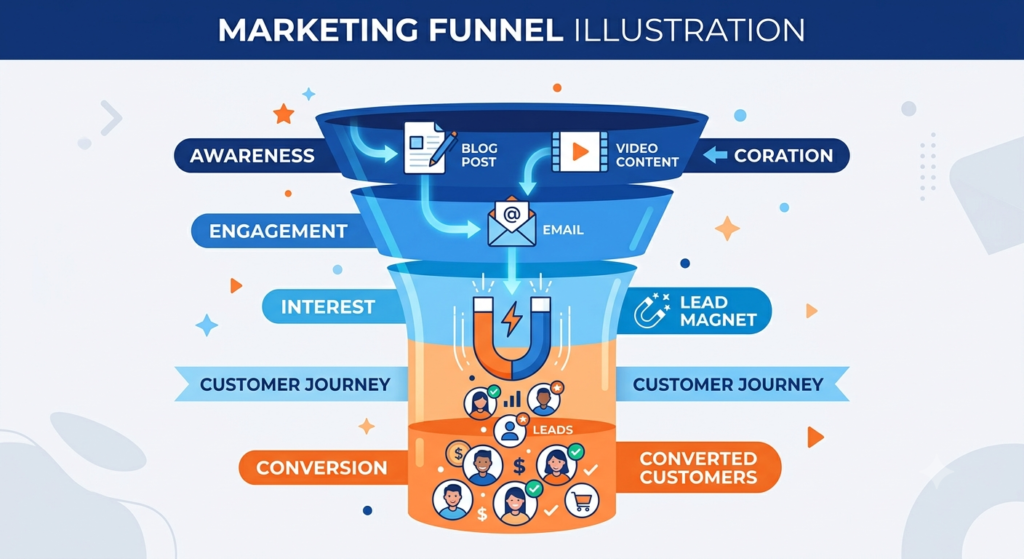
Publishing content isn’t the finish line — promotion is what actually gets it in front of your audience. A great article with zero distribution generates zero leads.
Promotion channels to prioritize:
- SEO — the long-term, compounding foundation of your promotion strategy
- LinkedIn — especially strong for B2B content marketing distribution
- Pinterest — high-value for e-commerce, lifestyle, and visual niches
- Facebook and Instagram — useful for community building and retargeting
- X (Twitter) — good for real-time engagement and thought leadership
- Reddit and Quora — answer real questions authentically; avoid overt self-promotion
- Email marketing — your highest-converting owned channel, since your list already opted in
- Influencer outreach — partner with niche voices to extend reach
- Communities — Slack groups, forums, and niche communities where your audience already gathers
💡 Expert Tip #12: Follow a “1:10 rule” — for every hour spent creating content, spend roughly ten times that promoting and repurposing it across channels.
Measure Content Marketing Performance
You can’t improve what you don’t measure. Tracking the right content marketing KPIs tells you what’s working, what’s wasting resources, and where to double down.
Metrics to track:
- Organic traffic
- Conversion rate (visitor to lead)
- Bounce rate
- Engagement (time on page, scroll depth)
- Leads generated
- Revenue attributed to content
- Customer acquisition cost (CAC)
- Marketing ROI
- Email list growth
Recommended analytics tools:
- Google Analytics 4 — core traffic and conversion tracking
- Google Search Console — keyword rankings and click-through data
- HubSpot — lead tracking and marketing attribution
- Ahrefs — backlink and ranking monitoring
- SEMrush — competitive and content gap analysis
💡 Expert Tip #13: Review performance monthly, but make major strategic decisions quarterly. Content SEO takes time to mature, and monthly overreaction to ranking fluctuations often leads to abandoning strategies too early.
Common Content Marketing Mistakes
Even well-intentioned teams sabotage their own lead generation with avoidable mistakes:
- Publishing without strategy — creating content reactively instead of against a plan
- Ignoring SEO — writing great content nobody can find
- No CTA — leaving readers with nowhere to go next
- Poor audience research — writing for “everyone,” which really means writing for no one
- Low-quality content — thin, generic content that fails to build trust or rank
- Inconsistent publishing — long gaps that stall SEO momentum and audience trust
- No analytics — flying blind with no way to know what’s working
- No lead magnet — generating traffic with no mechanism to capture leads
- Weak promotion — assuming “if you build it, they will come”
💡 Expert Tip #14: Run a quarterly content audit. Identify underperforming pages and either improve, consolidate, or remove them — a leaner, higher-quality content library often outperforms a bloated one.
Real-World Example of a Successful Content Marketing Funnel
Business challenge: A mid-sized B2B SaaS company selling HR software was publishing two blog posts a week but generating almost no leads. Traffic was flat, and nearly all content sat at the TOFU stage.
Strategy: The marketing team restructured their content around three pillar topics tied directly to buyer pain points, mapped content explicitly to TOFU, MOFU, and BOFU stages, and built one strong lead magnet per pillar.
Content created:
- TOFU: Long-form guides answering common HR questions, optimized around informational keywords
- MOFU: A comparison guide (“HR Software vs. Spreadsheets: A Cost Breakdown”) and two customer case studies
- BOFU: A demo request page and a “request a free HR process audit” offer
Distribution channels: Organic search, LinkedIn (targeting HR managers), and a biweekly email newsletter to existing subscribers.
Lead magnet: A downloadable “HR Compliance Checklist,” gated behind an email opt-in, promoted at the end of every TOFU blog post.
Email sequence: A five-part nurture sequence following checklist downloads, walking new leads through common HR pain points before introducing the product and offering a free audit.
Results: Within six months, organic traffic to the pillar content roughly doubled, and MQLs from content nearly tripled compared to the prior two quarters, since content now had a defined path from awareness to conversion.
Lessons learned: The traffic wasn’t the missing piece — the funnel was. Once content was mapped to buyer stages and paired with a relevant lead magnet, the same publishing effort converted at a dramatically higher rate.
FAQ
What is a content marketing strategy?
A content marketing strategy is a documented plan defining your target audience, goals, content types, funnel stages, and metrics — guiding what you publish and why.
How does content marketing generate leads?
It attracts visitors through valuable, search-optimized content, builds trust, and converts interested readers into leads through lead magnets and CTAs mapped to their stage in the buyer journey.
How long does content marketing take to show results?
Most businesses start seeing meaningful organic traffic and lead growth within four to nine months, though timelines vary by competition and consistency.
What type of content generates the most leads?
Bottom-of-funnel content like case studies, comparison guides, and free consultations tends to generate the highest-intent leads, though top-of-funnel content drives the traffic that feeds them.
Is SEO important for content marketing?
Yes. SEO is what makes content discoverable and gives it long-term compounding value instead of a short burst of visibility.
How often should businesses publish content?
Consistency matters more than raw frequency — one high-quality post per week sustained over a year outperforms sporadic bursts of daily publishing.
What are the best lead magnets?
Templates, checklists, and free tools tend to convert well at earlier funnel stages, while free audits and consultations convert better closer to a purchase decision.
Which tools should beginners use?
Google Search Console and Google Analytics 4 are free starting points; Ubersuggest is a budget-friendly option before investing in Ahrefs or SEMrush.
How do you measure content marketing success?
Track a mix of leading metrics (traffic, engagement) and lagging metrics (leads, revenue, CAC) rather than relying on traffic alone.
Can small businesses succeed with content marketing?
Yes — small businesses often outperform larger competitors in niche topics by producing more specific, genuinely useful content that larger brands overlook.
Conclusion
Building a content marketing strategy that generates leads isn’t about publishing more — it’s about publishing with purpose. Start by understanding your audience deeply. Set clear, measurable goals. Map your content to every stage of the buyer journey. Optimize relentlessly for search. And never publish a piece of content without a clear next step for the reader.
Do this consistently, and content stops being a cost center and starts becoming your most reliable, compounding source of qualified leads.
Ready to put this into action? Download our free content marketing strategy template to map out your own funnel, calendar, and KPIs in under 30 minutes — or schedule a free consultation with our team to build a custom strategy for your business.